
HPE7-J01 Advanced HPE Storage Architect Written Exam Topics and Questions
These HP Advanced HPE Storage Architect Written Exam (HPE7-J01) exam topics are organized according to official exam domains to help candidates quickly verify coverage and focus on assessment rather than theory. Each domain is paired with topic-wise HPE7-J01 sample questions that reflect how objectives are tested in the actual exam. This structure enables efficient review, targeted self-assessment, and rapid identification of weak areas when preparing for the HP Advanced HPE Storage Architect Written Exam certification exam.
Let's Practice Free HPE7-J01 Questions Aligned with Official Exam Topics
This topic carries fifteen per cent of the marks and establishes whether you can distinguish between storage architectures in ways that matter to a design decision. The exam tests your ability to choose the right technology for a given constraint, not your recall of feature lists. You need to know what each architecture costs the customer in latency, complexity, or scale, and when those costs are justified. Candidates lose marks when they confuse the conditions under which one architecture outperforms...
This topic carries fifteen percent of the marks and establishes whether you can distinguish between storage architectures in ways that matter to a design decision. The exam tests your ability to choose the right technology for a given constraint, not your recall of feature lists. You need to know what each architecture costs the customer in latency, complexity, or scale, and when those costs are justified. Candidates lose marks when they confuse the conditions under which one architecture outperforms another, or when they recommend a technology without accounting for the workload profile that makes it viable. The weight here signals that foundational knowledge is not a warmup section; it is a decision-making test from the first item onward.
How Differentiate, apply, and evaluate foundational storage architectures and technologies is tested
Fifteen percent means roughly one question in seven. Items present a scenario with specific performance, capacity, or availability requirements, then ask which architecture meets them without over-provisioning or introducing unnecessary risk. The exam rewards candidates who can trace a requirement back to the architectural trade-off it activates: block versus file versus object, scale-up versus scale-out, synchronous versus asynchronous replication. You will not be asked to define RAID levels or describe what SAN stands for. Instead, you will be given a workload profile and a constraint, and the item will hinge on whether you know which technology satisfies both. Candidates who rely on vendor marketing or who treat all flash arrays as interchangeable will choose options that sound plausible but fail under the stated conditions. The trap is always in the detail the scenario provides, not the detail it omits.
The practice test gives you scenarios that isolate a single architectural variable, so you learn to spot which detail controls the answer. The PDF format lets you work through the bank at your own pace and mark items where you confused one technology's constraints with another's, which is the most common pattern of error in this topic.
The question that follows requires you to match a workload requirement to the architecture that satisfies it without introducing a different bottleneck.
Refer to the exhibit.
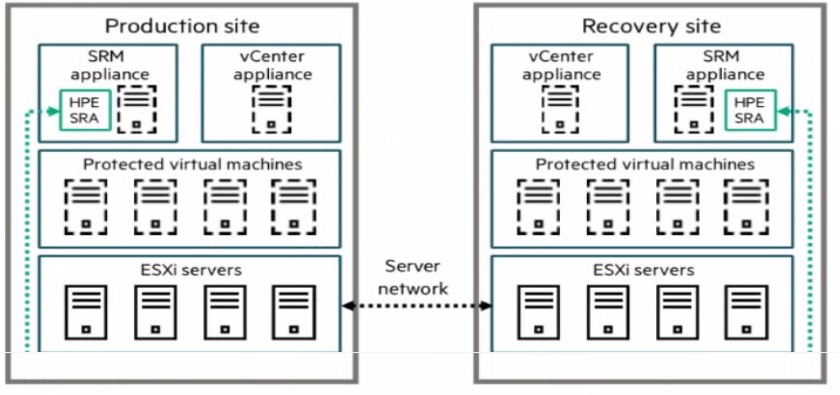
A company is implementing a disaster recovery solution. The Asynchronous Remote Copy feature has been implemented between the HPE AUetra 9000 arrays at both sites. The customer Is interested in providing a disaster recovery (DR) solution that allows for business connectivity of their VMware VMs.
Which VMware solution should the company implement?
At a quarter of the exam, this is the heaviest topic. It tests whether you can map a customer requirement to a specific HPE product, then build a complete solution that includes the right service tier and warranty coverage. The vendor wants to see that you know not only which array fits the workload, but also which controller configuration, which connectivity option, and which support contract matches the customer's risk tolerance. Candidates who treat this as a product-naming exercise will...
At a quarter of the exam, this is the heaviest topic. It tests whether you can map a customer requirement to a specific HPE product, then build a complete solution that includes the right service tier and warranty coverage. The vendor wants to see that you know not only which array fits the workload, but also which controller configuration, which connectivity option, and which support contract matches the customer's risk tolerance. Candidates who treat this as a product-naming exercise will run into trouble quickly, because the items expect you to justify every component in the stack and to recognise when a cheaper service tier leaves the customer exposed.
How Propose HPE storage products, solutions, design components, and warranty/service offerings is tested
Twenty-five percent means one question in four comes from this topic. Items describe a customer environment with explicit availability, performance, and budget constraints, then present options that differ in product model, controller count, connectivity type, or service level. The exam rewards candidates who can eliminate options that either under-deliver on a stated requirement or over-specify on a dimension the customer does not need. You must know which HPE array families support which features, and you must know the service tiers well enough to match response time and coverage to the customer's operational risk. The most common mistake is choosing the highest-performance product when the scenario prioritises cost, or selecting a service tier that does not cover the hours or the components the customer depends on. The trap is in the interaction between product capability and service scope, and the item will always give you enough information to spot the mismatch if you read the constraints carefully.
A full question bank shows you how product, component, and service variables combine across dozens of scenarios. Seeing the range of item styles before you sit the exam means you will not spend time in the test centre working out what the question is really asking.
The question below tests whether you can select a product and service combination that satisfies all stated requirements without exceeding the customer's tolerance for cost or complexity.
Which statement is correct regarding Fibre Channel over IP (FCIP)?
Ten per cent of the exam focuses on your ability to read a market context and identify where HPE storage addresses a gap or a shift in the customer's environment. This is not a sales-pitch topic. The items test whether you can distinguish a genuine opportunity from a situation where the customer's existing infrastructure already meets the need, or where a different intervention would deliver more value. You need to know the competitive landscape well enough to recognise when HPE's...
Ten percent of the exam focuses on your ability to read a market context and identify where HPE storage addresses a gap or a shift in the customer's environment. This is not a sales-pitch topic. The items test whether you can distinguish a genuine opportunity from a situation where the customer's existing infrastructure already meets the need, or where a different intervention would deliver more value. You need to know the competitive landscape well enough to recognise when HPE's approach solves a problem that other vendors leave open, and when it does not. Candidates lose marks when they recommend a storage refresh in a scenario where the bottleneck lies elsewhere, or when they fail to connect a stated business driver to the technical capability that supports it.
How Evaluate the storage market and recognize opportunities to apply HPE storage solutions to meet customer needs is tested
Ten percent translates to roughly one item in ten. Each item presents a customer situation with a mix of technical, operational, and business signals. The exam rewards candidates who can parse those signals and determine whether a storage solution is the right response, and if so, which aspect of HPE's portfolio aligns with the driver. You will see scenarios where the customer mentions cost pressure, compliance requirements, or application performance issues, and you must decide whether storage is the variable that moves the needle. The trap is always the plausible distractor: an option that sounds like it addresses the customer's language but does not resolve the underlying constraint. Candidates who rely on keyword matching rather than causal reasoning will choose options that feel relevant but do not change the outcome. The item rewards you for connecting cause to effect, not for recognising a product name in the stem.
Timed practice under test conditions helps you learn to read a scenario quickly and decide whether storage is the intervention that matters. The question bank gives you enough volume to see the patterns that separate a real opportunity from a distraction.
The scenario below asks you to determine whether a storage solution addresses the customer's stated constraint, and if so, which capability makes the difference.
Twenty per cent of the exam, and the longest design engagement you will face. This topic tests your ability to take a set of requirements and produce a detailed solution architecture that accounts for capacity, performance, redundancy, network topology, and future growth. The vendor expects you to show your working: not just the final array configuration, but the decisions that led you to choose one controller layout over another, one replication method over another, one zoning design over another. Candidates...
Twenty percent of the exam, and the longest design engagement you will face. This topic tests your ability to take a set of requirements and produce a detailed solution architecture that accounts for capacity, performance, redundancy, network topology, and future growth. The vendor expects you to show your working: not just the final array configuration, but the decisions that led you to choose one controller layout over another, one replication method over another, one zoning design over another. Candidates who jump straight to a product without checking the math on IOPS, throughput, or failover behaviour will find that the options expose those gaps. The weight here reflects the fact that design is where most projects succeed or fail, and the exam is built to surface whether you can do it under constraint.
How Plan and design HPE storage solutions is tested
Twenty percent means one question in five. Items give you a detailed requirements document: workload characteristics, growth projections, availability targets, and sometimes a network diagram or an existing infrastructure baseline. The exam rewards candidates who can translate those inputs into a design that satisfies every requirement without introducing a single point of failure or a performance cliff. You must know how to size capacity with headroom, how to calculate effective IOPS after RAID overhead, and how to design a fabric that survives a switch failure. The trap is the design that works in steady state but fails under load or during a fault. Candidates who do not check their design against the failure scenarios or the growth curve will choose an option that looks complete but cannot sustain the stated service level. The item will always give you the numbers you need; the challenge is knowing which calculation to perform and what the result tells you about viability.
The practice test lets you work through multi-part design problems in a controlled environment, so you learn to sequence your decisions and catch errors before you commit to an answer. Reviewing your misses across this topic shows you which design step you are skipping.
The scenario that follows requires you to produce a design that meets all stated requirements and survives the failure conditions described in the stem.
Fifteen per cent, and a shift in stance. Where the previous topic asked you to build a solution, this one asks you to audit one. You are given a proposed design and a set of requirements, and your job is to determine whether the design delivers what it promises. The exam tests whether you can spot a misconfiguration, an under-specification, or a hidden dependency that will cause the solution to fail in production. Candidates who assume that a design presented...
Fifteen percent, and a shift in stance. Where the previous topic asked you to build a solution, this one asks you to audit one. You are given a proposed design and a set of requirements, and your job is to determine whether the design delivers what it promises. The exam tests whether you can spot a misconfiguration, an under-specification, or a hidden dependency that will cause the solution to fail in production. Candidates who assume that a design presented in the stem must be correct will miss the items entirely. The weight tells you that validation is not a formality; it is a distinct skill, and the vendor expects you to demonstrate it under exam conditions.
How Evaluate the solution is tested
Fifteen percent means roughly one question in seven. Items describe a completed design, then ask whether it meets a specific requirement or whether it introduces a risk. The exam rewards candidates who can check a design against the requirements document and identify the point where it diverges: insufficient controller memory for the cache workload, a replication link that cannot sustain the write rate, a service tier that does not cover the recovery time objective. You will not be asked to approve a design that is merely suboptimal. The design will have a defect, and the defect will be specific and examinable. The trap is the design that looks plausible at first glance but fails when you run the numbers or trace the failure path. Candidates who do not perform the validation step, who rely on the fact that the design was presented as a serious option, will choose an option that endorses a broken solution. The item rewards you for checking, not for trusting.
The PDF question bank gives you the chance to review your evaluation method across multiple items, so you can see which validation checks you are performing and which you are skipping. That pattern is hard to spot without volume.
The question below presents a proposed design and asks whether it satisfies a stated requirement, or where it falls short.
Five per cent, the lightest topic, but one that tests a skill many candidates neglect: root cause analysis and the ability to recommend a corrective change. You are given a failure scenario, often with logs, symptoms, or a timeline, and you must determine what went wrong and what modification to the design would prevent a recurrence. The exam is not interested in generic best practices. It wants to see that you can trace a symptom back to a specific misconfiguration...
Five percent, the lightest topic, but one that tests a skill many candidates neglect: root cause analysis and the ability to recommend a corrective change. You are given a failure scenario, often with logs, symptoms, or a timeline, and you must determine what went wrong and what modification to the design would prevent a recurrence. The exam is not interested in generic best practices. It wants to see that you can trace a symptom back to a specific misconfiguration or design flaw, and that you can propose a change that addresses the root cause without introducing a new problem. Candidates who recommend a full redesign when a targeted fix would suffice, or who misread the failure mode and propose a change that does not touch the actual fault, will lose marks despite the low weight.
How Analyze relevant enterprise storage failures and advocate for changes to a solution is tested
Five percent means roughly one question in twenty, but that question will be dense. Items present a failure scenario with enough diagnostic detail to identify the root cause, then ask what change would prevent it. The exam rewards candidates who can distinguish between a symptom and a cause, and who can recommend a change that is proportionate to the fault. You will see scenarios where a performance issue is caused by a zoning error, or where a failover did not occur because a heartbeat path was not redundant, and the options will include both the targeted fix and several plausible but ineffective changes. The trap is the change that addresses a symptom or that introduces a different risk. Candidates who do not read the diagnostic detail carefully, or who do not verify that their proposed change actually prevents the failure mode described, will choose an option that sounds authoritative but does not solve the problem. The item rewards precision, not confidence.
Failure-analysis items are rare in the exam but they are high-stakes, because they often carry detail that you must parse under time pressure. Seeing a few examples in the practice test means you will recognise the structure and know which detail to extract first.
The scenario that follows describes a storage failure and asks you to identify the change that would prevent it from recurring.
Ten per cent, and the final test of integration skill. This topic assumes that the customer environment includes non-HPE components: third-party switches, hypervisors, backup appliances, or cloud gateways. Your job is to evaluate whether the HPE storage solution interoperates correctly with those components, and whether the integration introduces a constraint or a failure point that would not exist in a single-vendor stack. The exam tests your ability to read compatibility matrices, to understand the limitations that emerge at vendor boundaries,...
Ten percent, and the final test of integration skill. This topic assumes that the customer environment includes non-HPE components: third-party switches, hypervisors, backup appliances, or cloud gateways. Your job is to evaluate whether the HPE storage solution interoperates correctly with those components, and whether the integration introduces a constraint or a failure point that would not exist in a single-vendor stack. The exam tests your ability to read compatibility matrices, to understand the limitations that emerge at vendor boundaries, and to verify that the solution as a whole meets the requirements even when no single vendor controls the entire stack. Candidates who assume that standards compliance guarantees interoperability will find that the items expose the gaps that standards leave open.
How Evaluate complex and/or multi-vendor HPE storage solutions is tested
Ten percent means roughly one question in ten. Items describe a solution that spans multiple vendors, then ask whether a specific feature or service level is achievable given the integration constraints. The exam rewards candidates who know which capabilities require end-to-end vendor support and which can be delivered across a multi-vendor boundary. You will see scenarios where a feature works within the HPE array but cannot be surfaced through a third-party hypervisor, or where a replication topology is supported by each vendor individually but not in combination. The trap is the option that assumes feature parity across the stack. Candidates who do not check the interoperability matrix, or who do not recognize that a standard protocol does not guarantee full feature passthrough, will choose an option that claims the solution delivers something it cannot. The item rewards you for knowing where the boundaries are and what they cost the customer in functionality or performance.
Multi-vendor scenarios require you to hold several constraint sets in mind at once. The practice test gives you a safe environment to work through those scenarios and learn which integration points are the usual failure modes, so you can check them first under exam pressure.
The question below describes a multi-vendor solution and asks whether a stated capability remains available given the integration constraints.
Ready to Start Practicing?
Access all questions and start your exam preparation journey
Upgrade to Full HPE7-J01 Exam Questions 🚀


