
Applied Algebra (C957) Exam Topics and Questions
These WGU Applied Algebra (C957) exam topics are organized according to official exam domains to help candidates quickly verify coverage and focus on assessment rather than theory. Each domain is paired with topic-wise Applied Algebra (C957) sample questions that reflect how objectives are tested in the actual exam. This structure enables efficient review, targeted self-assessment, and rapid identification of weak areas when preparing for the WGU Applied Algebra certification exam.
Let's Practice Free WGU Applied Algebra (C957) Questions Aligned with Official Exam Topics
Algebra starts here, and so does the most common source of careless errors on this exam. This topic covers the mechanics you will use in every question that follows: how to simplify an expression correctly, how properties like distribution and association change what you can do to a term, and how to substitute a value and get the right number out. Get these wrong and errors compound through every later topic. How Algebraic Expressions and Operations is tested Items in...
Algebra starts here, and so does the most common source of careless errors on this exam. This topic covers the mechanics you will use in every question that follows: how to simplify an expression correctly, how properties like distribution and association change what you can do to a term, and how to substitute a value and get the right number out. Get these wrong and errors compound through every later topic.
How Algebraic Expressions and Operations is tested
Items in this topic tend to present an unsimplified expression or a partially worked simplification and ask you to identify the correct result or the next valid step. The order of operations is the most frequent trap: candidates who apply operations left-to-right without respecting grouping symbols and exponent priority will consistently land on a wrong value. A second common loss point is distribution across subtraction. When a negative is being distributed, a sign error on even one term changes the entire result.
Evaluation items give you specific variable values and ask for a numerical output. These reward methodical substitution before any simplification. Candidates who try to simplify first and substitute later often drop a sign or misread a coefficient. The strongest approach is to substitute the values in parentheses at every variable position, then work outward. Items also test whether you recognize equivalent forms of an expression, so knowing which properties justify each transformation matters as much as getting the arithmetic right.
The ITExamsTopics practice test lets you see exactly how expression and operations items are styled before you sit the real assessment. Running through a bank of these in timed conditions quickly reveals whether your order-of-operations instincts are reliable or whether a specific property is tripping you up.
The question below tests your ability to apply these mechanics under the kind of pressure the actual assessment creates.
The logistic function , whose graph is shown, models the number of people who have created a website account, where represents the number of days since the website started and represents the number of people who have created an account.
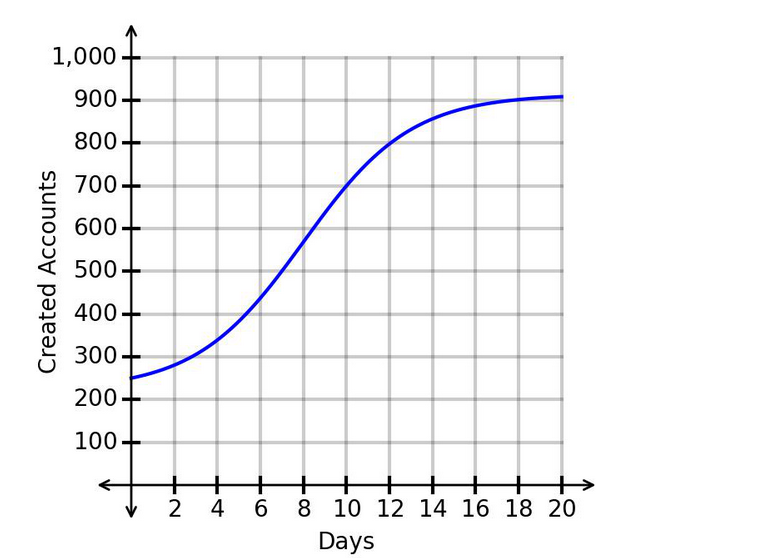
What is one range of values for which the graph is concave down?
Where the previous topic built the mechanical foundation, this one puts it to work in a directed way. Solving a linear equation is a sequence of reversible operations, and the exam is as interested in whether you can execute each step correctly as in whether you reach the right value. Inequalities add one critical wrinkle to that sequence. Word problems then ask you to construct the equation yourself before you solve it, which is where many candidates drop marks. How...
Where the previous topic built the mechanical foundation, this one puts it to work in a directed way. Solving a linear equation is a sequence of reversible operations, and the exam is as interested in whether you can execute each step correctly as in whether you reach the right value. Inequalities add one critical wrinkle to that sequence. Word problems then ask you to construct the equation yourself before you solve it, which is where many candidates drop marks.
How Linear Equations and Inequalities is tested
Single-variable equation items often present a multi-step problem where one operation is already done and you must continue from that point. The trap is accepting the partial work as correct when it contains an earlier sign or distribution error. Items reward checking each step rather than accepting prior lines at face value.
Inequality items test two things at once: solving the inequality correctly and representing the solution set accurately on a number line. Candidates lose marks by forgetting to flip the inequality symbol when multiplying or dividing by a negative number. That rule is tested directly and repeatedly.
Word-problem items are the most demanding in this topic. They reward the ability to identify what the variable represents, translate each sentence into an algebraic relationship, and then solve. The most common failure is setting up the equation incorrectly in the first place, which means a flawless solution process still produces a wrong answer. Read the problem twice before writing anything.
Working through a full question bank across this topic helps you spot which step in a multi-step solve is your personal weak point. The ITExamsTopics PDF lets you review item sets at your own pace and mark the ones where your setup, not your arithmetic, went wrong.
Try the question below to gauge how well you can translate a described situation into a solvable equation.
The graph shows the total cost of a lumber delivery based on the number of identical boards ordered.
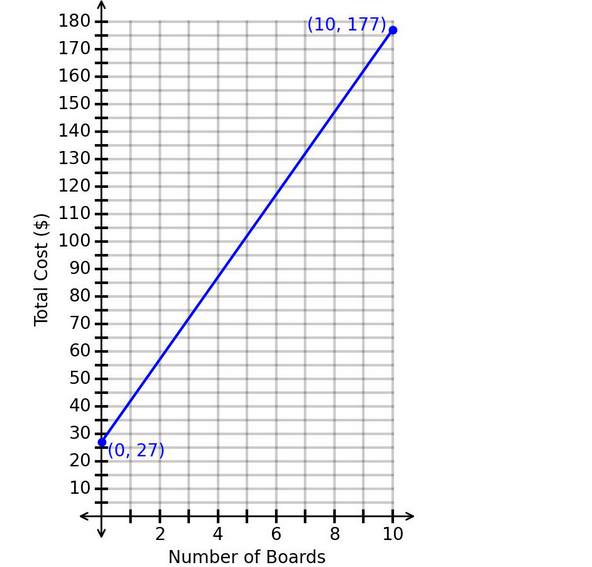
What is the cost of each additional board?
Equations become pictures here, and the exam tests whether you can move fluently between those two representations. Function notation is the language the topic uses throughout, so a shaky grasp of what f(x) means in practice will cost you marks even on items that are really about slope or intercepts. The real-world interpretation angle is what separates this topic from pure procedure: you are expected to say what a rate of change means, not just calculate it. How Graphing and...
Equations become pictures here, and the exam tests whether you can move fluently between those two representations. Function notation is the language the topic uses throughout, so a shaky grasp of what f(x) means in practice will cost you marks even on items that are really about slope or intercepts. The real-world interpretation angle is what separates this topic from pure procedure: you are expected to say what a rate of change means, not just calculate it.
How Graphing and Functions is tested
Function notation items test whether you can evaluate f(a) for a given value of a without confusing the notation for multiplication. That confusion is the primary trap. Items reward treating f(x) as an instruction to substitute, nothing more.
Graphing items give you an equation and ask about its graph, or give you a graph and ask about its equation. Slope and intercept are the key values in both directions. Candidates lose marks by mixing up which intercept is which, or by computing slope as run-over-rise rather than rise-over-run.
Interpretation items are the most context-dependent. They present a real-world scenario where a linear equation models something, then ask what the slope or y-intercept means in that context. The answer is always grounded in the units and the story, not in abstract algebra. Candidates who give a correct numerical slope but describe it in generic terms rather than in the context of the scenario will not earn full credit on these items.
Seeing a variety of graphing and function items in the ITExamsTopics practice test before your assessment helps you get comfortable with the different ways slope and intercept questions are framed, especially the context-based ones that trip up candidates who only practiced pure calculation.
The question below focuses on one of the interpretation scenarios this topic is known for testing.
Single equations give you one relationship; systems give you two at once, and the exam expects you to handle both the algebra and the geometry of that situation. The procedural side is substitution and elimination. The conceptual side is understanding what a solution point actually represents and what it means when a system has no solution or infinitely many. Applied scenarios then ask you to build the system from a word problem, which stacks all of those demands together. How...
Single equations give you one relationship; systems give you two at once, and the exam expects you to handle both the algebra and the geometry of that situation. The procedural side is substitution and elimination. The conceptual side is understanding what a solution point actually represents and what it means when a system has no solution or infinitely many. Applied scenarios then ask you to build the system from a word problem, which stacks all of those demands together.
How Systems of Equations is tested
Substitution items reward clean isolation of one variable before substituting. The trap is substituting an expression that has not been fully simplified, which introduces errors that are hard to catch mid-problem. Elimination items reward aligning coefficients correctly before adding or subtracting equations. Candidates who skip the alignment step and try to eliminate by inspection regularly produce incorrect multipliers.
Graphical interpretation items ask what the intersection point means, or what it means that two lines are parallel or identical. These items do not require calculation; they reward understanding the relationship between the algebraic and visual representations. Candidates who only practiced computation often stall here.
Applied scenario items are the highest-demand items in this topic. They require defining two variables, writing two equations from the problem description, solving the system, and then interpreting the solution in context. An error at any one of those four stages produces a wrong final answer, even if the remaining stages are done perfectly.
The ITExamsTopics question bank covers all three item types in this topic. Using it to check a weak area, say applied scenarios, is more efficient than re-reading a textbook chapter, because you immediately see whether your setup or your algebra is the actual problem.
The question below draws on one of the three item types described above and is representative of what this topic demands.
This topic closes the exam with two related skill sets that both depend heavily on rules. Exponent rules are compact and precise: a single misremembered rule, such as adding exponents when you should multiply them, corrupts every expression you touch. Polynomial arithmetic builds on that, and factoring asks you to run the multiplication process in reverse. If the earlier topics were about setting up and solving, this one is about manipulating structure. How Exponents and Polynomials is tested Exponent rule...
This topic closes the exam with two related skill sets that both depend heavily on rules. Exponent rules are compact and precise: a single misremembered rule, such as adding exponents when you should multiply them, corrupts every expression you touch. Polynomial arithmetic builds on that, and factoring asks you to run the multiplication process in reverse. If the earlier topics were about setting up and solving, this one is about manipulating structure.
How Exponents and Polynomials is tested
Exponent rule items present expressions that require applying multiple rules in sequence, such as a power of a product combined with a negative exponent. Items reward knowing each rule precisely and applying them in the right order. The most common error is treating a negative exponent as a negative number rather than as a reciprocal instruction.
Polynomial addition and subtraction items test whether you correctly identify and combine like terms. Candidates lose marks by combining terms with different variable powers. Multiplication items, especially those involving two binomials, reward systematic distribution across every term pair. Skipping a partial product is the primary error.
Factoring items are the most conceptually demanding. They reward recognizing the structure of an expression before choosing a method. Candidates who attempt to factor by trial and error without first identifying whether a greatest common factor exists waste time and frequently produce incomplete factorizations. Checking your factored form by expanding it is the fastest way to catch an error before submitting.
The free demo of the ITExamsTopics practice test lets you sample exponent and polynomial items before committing to the full bank, so you can judge whether the item style matches what you are seeing in your coursework before you decide.
Test your grasp of exponent rules or polynomial manipulation with the question directly below.
Ready to Start Practicing?
Access all questions and start your exam preparation journey
Upgrade to Full Applied Algebra (C957) Exam Questions 🚀


