
OMS-435 Build Guided Experiences with OmniStudio Exam Topics and Questions
These Salesforce Build Guided Experiences with OmniStudio (OMS-435) exam topics are organized according to official exam domains to help candidates quickly verify coverage and focus on assessment rather than theory. Each domain is paired with topic-wise OMS-435 sample questions that reflect how objectives are tested in the actual exam. This structure enables efficient review, targeted self-assessment, and rapid identification of weak areas when preparing for the Salesforce Build Guided Experiences with OmniStudio certification exam.
Let's Practice Free Salesforce OMS-435 Questions Aligned with Official Exam Topics
This is where the exam begins, and it sets the conceptual frame everything else depends on. Before you can build anything in OmniStudio, you need to know how its pieces fit together and why Salesforce designed the platform around the Industry 360 model. The questions here test orientation, not configuration. If you are fuzzy on the data model or how OmniStudio components sit within the broader architecture, that fuzziness will cost you marks on every downstream topic. – What Industry...
This is where the exam begins, and it sets the conceptual frame everything else depends on. Before you can build anything in OmniStudio, you need to know how its pieces fit together and why Salesforce designed the platform around the Industry 360 model. The questions here test orientation, not configuration. If you are fuzzy on the data model or how OmniStudio components sit within the broader architecture, that fuzziness will cost you marks on every downstream topic.
– What Industry 360 and OmniStudio actually are
Industry 360 is Salesforce's framing for a 360-degree view of customers within industry-specific clouds. The exam expects you to know what that framing means in practice: which business problems it addresses and how OmniStudio is the toolset that makes those solutions buildable without heavy custom code. OmniStudio is positioned as a declarative development platform, and the exam tests whether you understand its purpose in that context rather than just its name. You need to be clear on what differentiates OmniStudio from standard Salesforce development approaches and why an industry-focused organisation would reach for it.
– Architecture, data model and the component ecosystem
The data model and architecture sub-topic is where candidates most often underestimate the depth of knowledge required. OmniStudio's architecture involves specific relationships between its components: FlexCards, OmniScripts, Integration Procedures, and DataRaptors each occupy a defined layer. The exam will probe whether you know which layer handles what. The data model question is not abstract: it asks how OmniStudio stores and retrieves data relative to standard Salesforce objects. Understanding how these components interact with each other and with the underlying org data is the foundation for answering scenario-based items throughout the rest of the exam.
How Introduction to Industry 360 and Omnistudio is tested
Items from this topic tend to be definition and classification questions: given a scenario, identify which OmniStudio component or concept applies. The trap is confusing the purpose of one component with another. Candidates who have only skimmed the architecture often know the names of the components but misplace them in the stack. Items reward precision about where each component sits and what it is responsible for. The data model sub-topic frequently appears in questions where a candidate must identify the correct data source or relationship for a given use case. Answers that mix up DataRaptors with Integration Procedures, or conflate FlexCard data sources with OmniScript data sources, are the most common source of lost marks here. The weight of this topic is not published, so do not assume it is minor: the concepts it introduces underpin every other topic on the exam, and a shaky foundation will compound into errors later.
The ITExamsTopics practice test covers this topic alongside every other area of the exam in one purchase. Running through the full bank lets you spot which foundational concepts you have actually absorbed and which ones only feel familiar because you have read about them.
The question below puts one of this topic's core distinctions to the test. Work through it before moving on.
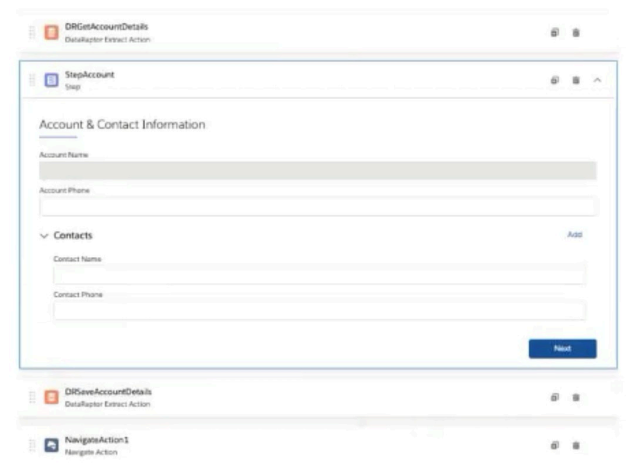
Refer to the exhibit.
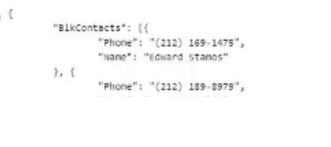
What JSON from the DRGetAccountDetails action would display all six values correctly in the OmniScript structure shown? BlkContacts is a Repeat Block.
A)
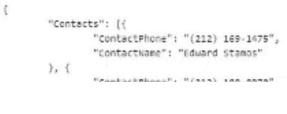
B)
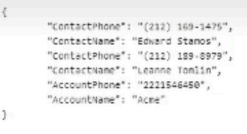
C)
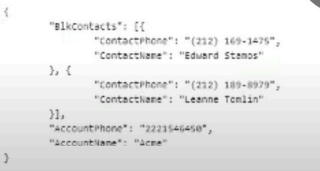
D)
Where the first topic gave you the platform's shape, this one fills in the processing engine underneath it. The Business Rules Engine, Document Generation, the Data Processing Engine, and the rest of the tools covered here are the services that OmniStudio solutions call on when declarative configuration alone is not enough. This topic has the widest spread of named components on the exam, which means you need to know what each one does and, critically, when you would choose it...
Where the first topic gave you the platform's shape, this one fills in the processing engine underneath it. The Business Rules Engine, Document Generation, the Data Processing Engine, and the rest of the tools covered here are the services that OmniStudio solutions call on when declarative configuration alone is not enough. This topic has the widest spread of named components on the exam, which means you need to know what each one does and, critically, when you would choose it over an alternative.
– Rules, decisions and explainability
The Business Rules Engine is the heart of this group. It separates business logic from process flow so that rules can be updated without rebuilding the surrounding OmniScript or Integration Procedure. The exam tests whether you understand that distinction, not just the fact that BRE exists. Lookup Tables and Decision Tables are both ways to externalise logic, but they serve different scenarios: one handles simple data retrieval, the other evaluates conditions across multiple inputs. Expression Sets take that further by allowing mathematical and logical expressions to be composed and reused. Decision Explainer sits on top: it surfaces the reasoning behind a BRE outcome to the end user or agent. Items in this group often hinge on choosing the right tool for a described business rule scenario, so know what each component produces and when each is appropriate.
– Document generation and intelligent reading
Document Generation (Doc Gen) produces formatted output documents from Salesforce data. The exam focuses on where Doc Gen fits in a solution: it is invoked from a process, not a standalone tool, and the questions reflect that. You need to know what triggers it and what data it can access. Intelligent Document Reader goes in the other direction: it extracts structured data from uploaded documents and maps that data into Salesforce fields. The distinction between these two is frequently tested. Candidates who conflate them tend to misidentify which component to use when a scenario describes inbound versus outbound document handling. Know the direction of data flow for each.
– Processing on the client, the server and in bulk
Client-Side Processing and Server-Side Processing refer to where OmniScript logic executes. Client-side actions happen in the browser without a server round-trip; server-side actions call Apex or Integration Procedures. The exam tests your ability to identify which mode is appropriate for a given action, and the deciding factors usually come down to data access requirements and performance considerations. The Data Processing Engine handles high-volume batch operations on Salesforce data, making it a different category altogether. It is not a real-time component. Items on this sub-topic ask you to match a described workload to the correct processing mechanism, so be clear on the boundaries between all three.
How Introduction to Additional Flow for Industries Processes and Services is tested
This topic generates some of the most component-dense questions on the exam. You will be given a business scenario and asked to identify which service or combination of services satisfies the requirement. The volume of named components means the distractor options are plausible: all of them are real OmniStudio tools. Items reward the ability to match a described need to the component designed for it, rather than the component that sounds closest. The most common errors come from candidates who know what each component is called but are unclear on what it produces or where it runs. Expression Sets versus Decision Tables is a frequent confusion point, as is Doc Gen versus Intelligent Document Reader. Timed practice on this topic is especially useful because the scenarios can be long and the differences between answer options are sometimes narrow. Read the scenario's direction of data flow and the scale of the operation before committing to an answer.
With nine distinct components in this topic, gaps in coverage are easy to miss until the exam reveals them. Working through the ITExamsTopics practice test under timed conditions shows you which components you are consistently misidentifying before that mistake costs you on the day.
The question below tests your ability to match a specific business need to the right component from this topic.
A developer needs to build a multi-step intake form. Each step must allow the user to cancel the intake at any time. The developer is using an LWC OmniScript to build the form.
How should the developer implement thecancel functionality for all steps using the LWC OmniScript Designer?
After two topics that covered the landscape at altitude, this one brings you down to the level of the designer tools you will actually use to build. Knowing component types and best practices matters here because exam scenarios describe a build situation and expect you to identify the right component or the right configuration approach. This is also where understanding the designer interfaces pays off: if you have never navigated a component designer, the scenario-based items will be harder to...
After two topics that covered the landscape at altitude, this one brings you down to the level of the designer tools you will actually use to build. Knowing component types and best practices matters here because exam scenarios describe a build situation and expect you to identify the right component or the right configuration approach. This is also where understanding the designer interfaces pays off: if you have never navigated a component designer, the scenario-based items will be harder to parse.
How Omnistudio Components is tested
Items here tend to be scenario-based: a developer is building a solution with a described requirement, and you must identify which component type applies or which best practice should govern the build decision. The trap is picking a component that could work in isolation rather than the one that is correct for the specific scenario. Best practices sub-topics are particularly prone to distractor options that are defensible in general but wrong for the described context. Items reward knowing what each component does, what its designer exposes, and what it does not allow. Candidates who have only read about the designers without working through them tend to misidentify configuration options. This topic overlaps with later topics on FlexCards and OmniScripts, so a weak result here often predicts weak results there too. Treat it as a prerequisite check before moving into the build-focused topics that follow.
The ITExamsTopics PDF gives you a static reference you can work through offline, while the practice test lets you check your component knowledge against item-style questions. Both are included in a single purchase with a free demo available.
The question below asks you to apply component knowledge to a specific build scenario. Read it carefully before checking your reasoning.
FlexCards are the display layer of OmniStudio solutions, and this topic moves well past the basics. The parent-child relationship is where most candidates run into trouble because it combines structural knowledge (how cards nest) with data knowledge (where each card gets its data) and deployment knowledge (how the finished card set reaches users). With nine sub-topics, this is a detailed area, and the exam reflects that depth. – Understanding the use case and the parent-child model The exam often opens...
FlexCards are the display layer of OmniStudio solutions, and this topic moves well past the basics. The parent-child relationship is where most candidates run into trouble because it combines structural knowledge (how cards nest) with data knowledge (where each card gets its data) and deployment knowledge (how the finished card set reaches users). With nine sub-topics, this is a detailed area, and the exam reflects that depth.
– Understanding the use case and the parent-child model
The exam often opens a FlexCard scenario by describing an Industry 360 use case: a service agent needs to see account summary data alongside related asset details, for example. Your job is to recognise which part of that display belongs on a parent card and which belongs on a child. The parent-child relationship is not just visual nesting: it defines data inheritance. A child FlexCard can receive data from its parent, but it can also have its own independent data source. The exam tests both arrangements. Candidates who treat the parent-child relationship as purely structural, without accounting for the data flow between cards, tend to select the wrong configuration when a scenario describes a card that needs data the parent does not have.
– Data sources and card states
FlexCard data sources include DataRaptors, Integration Procedures, Apex, and custom JavaScript. The exam expects you to know which source is appropriate for a described data need and how a child card's data source differs from its parent's when they are not sharing data. FlexCard States add conditional logic to the display: a card can show different content depending on the state of the record or the user's context. Building states correctly means knowing how conditions are evaluated and what triggers a state change. This is a frequent source of exam questions because states are easy to misconfigure in ways that look correct until a specific condition is met.
– Building, embedding and deploying
The build sub-topics cover styling a child FlexCard and embedding it inside a parent. Styling questions on the exam are less about visual design and more about which configuration options control the display behaviour. Embedding a child card requires understanding the slot mechanism and how data is passed at the point of embedding. Deployment is the final step: building a Lightning Application to host and expose the FlexCard set. The exam tests whether you know what a Lightning App requires to surface a FlexCard correctly in an Industry 360 context. Deployment errors, particularly around the app configuration, are a common source of lost marks for candidates who focused their preparation on the build steps and skipped the deployment details.
How Parent and Child Flexcards in Industry 360 Solutions is tested
Scenario items in this topic describe a display requirement and ask you to identify the correct card structure, data source, or deployment configuration. The parent-child relationship generates the most distractors: options will describe plausible but incorrect data flow arrangements, and the item rewards the candidate who can trace the data from its source through the parent to the child and back. State configuration items reward knowing the exact condition logic, not just that states exist. Deployment questions are often the ones candidates skip in preparation and then lose marks on in the exam. The Lightning App configuration for FlexCards has specific requirements that are easy to overlook. Work through the full build-to-deploy cycle in your preparation rather than stopping at the point where the card looks correct in the designer.
Checking your FlexCard knowledge against practice questions is more efficient than re-reading documentation. The ITExamsTopics practice test lets you identify exactly which part of the parent-child model you are misapplying, so you can target that gap rather than reviewing everything.
The question below draws on the parent-child FlexCard model. Work out your answer before reading ahead.
This topic shifts from component knowledge to end-to-end solution building. The problem reporting use case is the first fully worked scenario in the exam, and it tests whether you can connect the components you have studied into a coherent solution. OmniScripts, DataRaptors, Integration Procedures, and FlexCards all appear here, but the exam is not just checking whether you know each one: it is checking whether you know how they work together when a real user need drives the design. –...
This topic shifts from component knowledge to end-to-end solution building. The problem reporting use case is the first fully worked scenario in the exam, and it tests whether you can connect the components you have studied into a coherent solution. OmniScripts, DataRaptors, Integration Procedures, and FlexCards all appear here, but the exam is not just checking whether you know each one: it is checking whether you know how they work together when a real user need drives the design.
– Designing the solution and building the data layer
Before any component is built, the exam expects you to understand the design step: given a problem reporting requirement, what does the solution need and in what order should the pieces be built? The Data Mapper (DataRaptor) that displays asset and account data is the foundation. Items on this sub-topic test whether you know how to configure a Data Mapper to retrieve the right fields from the right objects and surface them in an OmniScript. Candidates who jump straight to OmniScript configuration without understanding the data retrieval layer tend to misidentify the correct Data Mapper type for a described retrieval scenario.
– OmniScript elements: capture, upload and type-ahead
The OmniScript built in this use case captures case data, and the exam tests the specific elements involved. A File Upload element handles attachments, and the exam may probe its configuration options, including what it accepts and where the file is stored. The Type Ahead Block is a search-as-you-type element that queries data while the user types. Knowing when to use a Type Ahead Block versus a standard lookup is a tested distinction. The user experience refinement sub-topic covers layout and conditional visibility within the OmniScript. Items here reward knowing which element property controls a described behaviour, not just that the element exists.
– Integration, branching and deployment via FlexCard
The branching Integration Procedure is where the problem reporting solution gets its conditional logic. Branching in an Integration Procedure means different execution paths run depending on evaluated conditions. The exam tests your ability to identify when branching is needed and how it is configured. Testing and deployment in this use case involve surfacing the completed OmniScript through a FlexCard, which means you need to know how a FlexCard action invokes an OmniScript and what configuration that requires. Candidates who have not worked through the deployment step in their preparation often lose marks on the final sub-topic because the invocation configuration has specific requirements that are not obvious from the designer alone.
How Problem Reporting with Omnistudio is tested
Items in this topic are scenario-driven and often sequential: you are told what has already been built and asked what to do next, or you are told a specific element is behaving incorrectly and asked to identify the cause. The branching Integration Procedure is a frequent item focus because branching conditions are easy to misconfigure. Items reward knowing the precise configuration that produces the described outcome, not just the general concept. File Upload and Type Ahead Block items tend to test configuration options rather than existence, so surface-level familiarity is not enough. The deployment sub-topic generates items where the distractor options describe configurations that would work in a different context but not for a FlexCard-invoked OmniScript. Trace the full path from data source through OmniScript element to FlexCard action when you encounter a scenario that spans multiple components.
A question bank gives you exposure to the scenario format this topic uses before you sit the real exam. The ITExamsTopics practice test includes questions across the full problem reporting workflow, so you can check your end-to-end understanding rather than testing components in isolation.
The question below presents a problem reporting scenario. Identify what the solution requires before selecting your answer.
The customer onboarding use case takes the OmniScript skills from the previous topic and pushes them further. Conditional views, repeating blocks, error checking, and a Data Mapper Transform all appear here, making this one of the more technically detailed OmniScript topics on the exam. The deployment step also changes: this time the OmniScript lands on an Application Home Page rather than a FlexCard, so the deployment configuration is different from what you practised in the problem reporting topic. – Conditional...
The customer onboarding use case takes the OmniScript skills from the previous topic and pushes them further. Conditional views, repeating blocks, error checking, and a Data Mapper Transform all appear here, making this one of the more technically detailed OmniScript topics on the exam. The deployment step also changes: this time the OmniScript lands on an Application Home Page rather than a FlexCard, so the deployment configuration is different from what you practised in the problem reporting topic.
– Conditional logic and dynamic content within the OmniScript
Conditional Views hide or show sections based on evaluated conditions. The exam tests the condition logic, not just the fact that the feature exists. A candidate who knows that Conditional Views exist but cannot specify how the condition is written will lose marks on items that describe a display requirement and ask which configuration produces it. Repeating Blocks allow a user to add multiple instances of a data entry group, which is common in onboarding flows where a customer might add several contacts or addresses. The exam tests both the configuration of the block itself and how the repeated data is structured in the OmniScript's JSON output, because that JSON is used downstream by the Data Mapper Load.
– Text blocks, error checking and the integration layer
Text Blocks in an OmniScript display dynamic or static content inline. The exam may probe how merge fields work within a Text Block to surface data already captured earlier in the script. Error checking configuration determines what happens when a user submits invalid data: the exam tests what triggers an error state and what the OmniScript does in response. The Integration Procedure with a Data Mapper Transform is a more complex data operation than a straight retrieval: the Transform step manipulates data between the Integration Procedure's input and its output. Items here reward knowing what a Transform does that a simple Extract or Load does not.
– Confirmation, JSON reuse and deployment
The confirmation step uses a Lookup Element to surface a record that was created or updated earlier in the flow, giving the user feedback that the onboarding succeeded. The exam tests how the Lookup Element is configured to find the right record. Using the OmniScript's JSON to create a Data Mapper Load is an important pattern: the JSON produced by the OmniScript at runtime becomes the input for a DataRaptor Load that writes data to Salesforce. Candidates who do not understand how OmniScript JSON is structured will struggle to identify the correct field mapping in a Load scenario. Deployment on an Application Home Page has different requirements from embedding in a FlexCard, and the exam expects you to know the distinction.
How Customer Onboarding with Omnistudio is tested
This topic generates multi-step scenario items where you must trace data from its entry point in the OmniScript through a Transform to a DataRaptor Load and finally to the Salesforce record. Items reward understanding the data shape at each step. The Repeating Block and its downstream JSON structure is a high-value area: candidates who have not worked through how repeated data is represented in JSON tend to misidentify the correct DataRaptor Load mapping. Conditional View items test condition syntax rather than the feature concept, so vague familiarity is not enough. Error checking items often present a scenario where the described behaviour is almost but not quite what the configuration produces, requiring you to identify the precise misconfiguration. Deployment items on this topic are distinct from the previous topic's deployment scenario, and treating them as interchangeable is a common error.
The ITExamsTopics practice test lets you see how this topic's multi-step scenarios are structured as exam items. Reviewing your results by topic helps you identify whether your gaps are in the OmniScript configuration, the data mapping, or the deployment step.
The question below covers one of the configuration patterns central to this onboarding use case. Read the scenario fully before answering.
Eligibility determination is one of the most common real-world OmniStudio use cases, and this topic reflects that by combining nearly every component type the exam covers. An SLA use case drives the build, and the scenario requires an Expression Set for pricing logic, a FlexCard embedded inside an OmniScript, a Disclosure Element for compliance, and a Data Mapper Load to create an Opportunity. That breadth means this topic rewards candidates who have a solid grasp of all the preceding material....
Eligibility determination is one of the most common real-world OmniStudio use cases, and this topic reflects that by combining nearly every component type the exam covers. An SLA use case drives the build, and the scenario requires an Expression Set for pricing logic, a FlexCard embedded inside an OmniScript, a Disclosure Element for compliance, and a Data Mapper Load to create an Opportunity. That breadth means this topic rewards candidates who have a solid grasp of all the preceding material.
– Use cases, the SLA OmniScript and embedded FlexCards
The exam opens this topic's scenarios by describing eligibility or SLA requirements and asking you to identify the appropriate solution design. The SLA OmniScript build covers configuration steps that are specific to the SLA context: capturing agreement terms, evaluating conditions, and presenting results. Embedding a FlexCard inside an OmniScript is a reversal of the deployment pattern from Topic 4, where a FlexCard invoked an OmniScript. Here the OmniScript hosts the FlexCard. The exam tests both directions, and candidates who only know one tend to misidentify the configuration when the other is described. Know how data is passed to an embedded FlexCard from the OmniScript's data context.
– Branching, Expression Sets and pricing logic
Branching in this topic is implemented using a Set Values Element with the Expression Editor, which is a different mechanism from the branching Integration Procedure in Topic 5. The Expression Editor in a Set Values Element evaluates conditions and assigns values to OmniScript fields, driving which path the script takes. Expression Sets handle the pricing calculation: they apply configurable rules to input values and return a calculated result. The exam tests whether you know how to configure an Expression Set for a discount calculation scenario, including which input fields are required and how the output is mapped. Candidates who conflate Expression Sets with Decision Tables or BRE rules in general will lose marks on items that ask for the specific component that performs a calculation.
– Disclosure, data seeding, Opportunity creation and deployment
The Disclosure Element presents terms or conditions that a user must acknowledge before the OmniScript can proceed. The exam tests its configuration: what triggers it, what it requires from the user, and what happens if the user declines. Seeding data with a Set Values Element means pre-populating OmniScript fields with values derived from earlier steps or external sources, which reduces the data entry burden and ensures consistency. Creating an Opportunity with a Data Mapper Load is the write-back step: the exam tests the correct Load configuration for Opportunity creation, including field mapping and the handling of related records. Deployment on a Record Detail Page, the final sub-topic, has its own configuration requirements distinct from both the Application Home Page and the FlexCard deployments covered earlier.
How Product and Program Eligibility with Omnistudio is tested
This topic produces some of the most integration-heavy scenario items on the exam. You will be asked to identify the correct component or configuration at a specific point in a multi-step eligibility flow. The Expression Set and Set Values Element branching sub-topics are high-risk areas because the two mechanisms look similar in a scenario description but produce different outcomes. Items reward the candidate who can distinguish between a value assignment and a rule-based calculation. The Disclosure Element is often tested with a scenario that describes an edge case: what happens when the user does not accept the disclosure. Know the downstream effect. Data Mapper Load configuration for Opportunity creation is tested with enough specificity that vague knowledge of DataRaptors is not sufficient. Deployment on a Record Detail Page generates items where the distractor options describe valid deployment approaches for other contexts, so read the deployment target carefully before selecting.
This topic spans more component types than any other on the exam. The ITExamsTopics practice test covers the full range, and working through questions here tells you whether you can apply each component correctly in an eligibility context rather than in the abstract.
The question below places you inside an eligibility scenario and asks about a specific configuration decision. Take your time with it.
The previous topics built solutions from scratch. This one asks what happens when requirements change after the solution is live. Extending and customising standard components, updating FlexCards and their data sources, and adjusting OmniScripts are all change-management tasks that require you to understand not just the original build but the dependencies that a change can break. This is where candidates who learned to build but did not learn to maintain will lose marks. How Solution Adjustments in Response to Changing...
The previous topics built solutions from scratch. This one asks what happens when requirements change after the solution is live. Extending and customising standard components, updating FlexCards and their data sources, and adjusting OmniScripts are all change-management tasks that require you to understand not just the original build but the dependencies that a change can break. This is where candidates who learned to build but did not learn to maintain will lose marks.
How Solution Adjustments in Response to Changing Requirements is tested
Items in this topic describe a working solution and a new requirement, then ask what change is needed and how to make it safely. The trap is selecting an option that satisfies the new requirement but breaks an existing dependency. Extending a standard OmniStudio component, for example, has specific constraints: some properties can be overridden, others cannot, and the exam tests which is which. FlexCard data source updates require you to know how a change to the source affects the card's field bindings. OmniScript adjustments that alter the data structure can invalidate a downstream DataRaptor Load, and items reward the candidate who identifies that dependency before committing to the change. This topic is relatively narrow in scope, but the items are precise. A surface-level answer that describes the right general approach will often match a distractor option rather than the one that accounts for the specific constraint described in the scenario.
Change-management scenarios are harder to prepare for by re-reading documentation because the exam tests the interaction between components, not the components individually. The ITExamsTopics practice test exposes you to that interaction pattern so you can practise tracing dependencies before the exam.
The question below presents a change scenario. Identify the dependency at risk before you select your answer.
The capstone topic represents the exam's final demand: given a set of specific requirements, design a complete OmniStudio solution. This is not a question about one component or one configuration step. It requires you to draw on every preceding topic and make design decisions about which components to use, how they connect, and in what order they should be built. If any earlier topic left a gap in your knowledge, it is most likely to surface here, because the capstone...
The capstone topic represents the exam's final demand: given a set of specific requirements, design a complete OmniStudio solution. This is not a question about one component or one configuration step. It requires you to draw on every preceding topic and make design decisions about which components to use, how they connect, and in what order they should be built. If any earlier topic left a gap in your knowledge, it is most likely to surface here, because the capstone scenario will touch on it.
How Capstone Activity is tested
Capstone items are the most complex on the exam. They describe a business requirement in enough detail that multiple solution designs are plausible, and the item rewards the one that is correct for the described constraints. The distractor options are not wrong in general: they describe valid OmniStudio approaches that do not fit the specific requirement. Candidates who have prepared topic by topic but have not practised integrating their knowledge across topics will find these items the hardest to complete under time pressure. The most common error is selecting a design that solves the stated requirement but ignores an implied constraint in the scenario. Read the full scenario before eliminating options, because the constraint that rules out a plausible design is often in the last sentence. This topic also tests deployment decisions: the correct deployment target for a capstone scenario depends on the use case described, not on a default preference.
The free demo on ITExamsTopics lets you see the practice test format before committing. For a capstone topic that tests your ability to integrate everything, working through questions from all topics in sequence under timed conditions is the most effective final preparation step.
The question below is a capstone-style item that draws on the full scope of the exam. Approach it the same way you would in the real test.
Ready to Start Practicing?
Access all questions and start your exam preparation journey
Upgrade to Full OMS-435 Exam Questions 🚀


