
SY0-801 CompTIA Security+ Certification Exam (New Version) Exam Topics and Questions
These CompTIA Security+ Certification Exam (New Version) (SY0-801) exam topics are organized according to official exam domains to help candidates quickly verify coverage and focus on assessment rather than theory. Each domain is paired with topic-wise SY0-801 sample questions that reflect how objectives are tested in the actual exam. This structure enables efficient review, targeted self-assessment, and rapid identification of weak areas when preparing for the CompTIA Security+ Certification Exam (New Version) certification exam.
Let's Practice Free CompTIA SY0-801 Questions Aligned with Official Exam Topics
This topic sets the vocabulary and mental models the rest of the exam assumes you already have. It covers the foundational principles, the taxonomy of controls, the discipline of change management, and the mechanics of cryptography. The places it costs candidates marks are not the definitions themselves but the distinctions within them: knowing when a control is compensating rather than corrective, or why key length matters in a given context. – Foundational principles and control taxonomy CIA is the starting...
This topic sets the vocabulary and mental models the rest of the exam assumes you already have. It covers the foundational principles, the taxonomy of controls, the discipline of change management, and the mechanics of cryptography. The places it costs candidates marks are not the definitions themselves but the distinctions within them: knowing when a control is compensating rather than corrective, or why key length matters in a given context.
– Foundational principles and control taxonomy
CIA is the starting frame, but the exam tests it situationally: a scenario will describe an event and you need to identify which property was violated and why. The same applies to AAA and non-repudiation. Zero Trust and least privilege appear together because they share a logic: never assume access is warranted and always grant the minimum that the task requires. Control categories (technical, managerial, physical, operational) and control types (preventive, deterrent, corrective, detective, compensating, directive) are a matrix you need to navigate quickly. The trap is confusing category with type. A camera is a physical control; depending on its role in a scenario it might be deterrent or detective. A policy is managerial; its type depends on whether it stops, detects, or guides behaviour. Defense in depth is the principle that ties these together: no single control is sufficient, and layering controls across categories and types is what the exam rewards.
– Change management and its security consequences
Change management shows up here because poorly controlled change is one of the most common sources of security incidents. The CAB, approval process, and maintenance windows exist to ensure changes are reviewed before they introduce new exposure. The exam will give you a scenario where something broke after a change and ask you to identify what safeguard was missing or which step was skipped. Backout planning and fail-forward decisions are testable: when do you roll back versus accept the risk and move forward? Allow lists and deny lists are change-related because updating them is a controlled activity with its own approval chain. Dependencies and legacy applications are traps in scenario questions because a change that looks safe in isolation can break a dependent system. Documentation, version control, and keeping diagrams current are not administrative busywork in exam terms: they are the audit trail that makes future changes safer and the evidence that controls were in place.
– PKI and certificate management
The PKI sub-topic is dense and the exam tests it at a level of precision that surprises many candidates. Certificate authorities, the chain of trust, root of trust, and CSR generation are all fair game. The distinction between CRLs and OCSP matters because they answer the same question (is this certificate still valid?) through different mechanisms with different performance and availability trade-offs. Self-signed versus third-party certificates carry different trust implications. Wildcard certificates cover a domain and all its immediate subdomains, which creates a specific risk profile if the private key is compromised. Key escrow is tested in the context of organisational key recovery, not as an abstract concept. Know what each certificate field means and what happens when revocation checking fails.
– Encryption, algorithms, and cryptographic tools
Symmetric and asymmetric encryption are not just definitions here: the exam tests which one is appropriate in a given scenario and why. Key exchange is where asymmetric cryptography earns its place, even in systems that use symmetric encryption for bulk data. Encryption levels (full disk, partition, file, volume, database, record, transport) appear in scenarios that describe a specific data protection requirement and ask which level addresses it. Key length, algorithm choice, and digital signatures are tested together because they are all decisions with security consequences that depend on context. Hashing, salting, and obfuscation are often confused with each other and with encryption: the exam exploits that confusion. Salting is specifically about defeating precomputed hash attacks. Obfuscation makes something harder to understand but does not guarantee confidentiality. Know which tool solves which problem.
How General Security Concepts is tested
At 16% of the exam, this topic appears throughout the paper, often embedded in scenarios that seem to be about something else. An item about an incident response decision might hinge on which control type was bypassed. A question about a certificate error might require you to distinguish OCSP from CRL behaviour under specific network conditions.
Items in this topic reward precision over familiarity. Knowing that compensating controls exist is not enough: you need to recognise the scenario where one is the best available option rather than the preferred one. Similarly, the cryptography items reward understanding trade-offs, not reciting algorithm names.
The most common place candidates lose marks is on the control matrix. They confuse category with type, or they pick a control that is plausible but addresses the wrong property. The second trap is in the change management items: candidates focus on the technical implications and miss the documentation or approval step that the scenario is actually testing. Read every scenario for what was skipped, not just what was done.
The ITExamsTopics practice test for Security+ covers all five topics, including the full spread of General Security Concepts scenarios. Running through the bank lets you spot the specific control-category confusions and cryptography trade-off questions you are getting wrong before the real exam, rather than discovering the pattern after the fact.
The question below puts one of the control-type distinctions from this topic into a scenario context. Work through it before checking your reasoning.
Which of the following is best suited to monitor and control the outbound movement of sensitive file content?
The largest topic on the exam by weight, this one demands breadth as much as depth. You are expected to recognise threat actors by their attributes and motivations, map attack vectors to the delivery mechanism in a scenario, identify vulnerability types before they are exploited, read indicators of compromise correctly, and account for the specific risks that AI systems introduce. The cost of shallow coverage here is high: a single confused classification can cascade into three wrong answers. – Threat...
The largest topic on the exam by weight, this one demands breadth as much as depth. You are expected to recognise threat actors by their attributes and motivations, map attack vectors to the delivery mechanism in a scenario, identify vulnerability types before they are exploited, read indicators of compromise correctly, and account for the specific risks that AI systems introduce. The cost of shallow coverage here is high: a single confused classification can cascade into three wrong answers.
– Threat actors, motivations, and attributes
The exam does not test threat actors as a memory exercise. It presents a scenario describing an attack pattern and asks you to identify the most likely actor or the motivation that best fits the evidence. State-sponsored actors and crime syndicates differ not just in motivation but in resources, persistence, and target selection. Unskilled attackers and hacktivists both have limited sophistication but for entirely different reasons and with different target profiles. Insider threats are particularly tricky because the actor has legitimate access, which changes which indicators matter. Motivations such as financial gain, espionage, ideological conviction, notoriety, and extortion are not interchangeable: the motivation shapes the attack pattern, and the exam uses that relationship. Internal versus external, level of sophistication, and available funding are the three attributes that narrow down actor type when motivation alone is ambiguous.
– Threat vectors and delivery mechanisms
This is where the exam tests whether you can trace an attack back to its entry point. Message-based vectors cover email, SMS, RCS, instant messaging, and collaboration tools: each has specific social engineering variants associated with it. Image-based vectors including QR codes and embedded content are tested because they bypass text-based filters. Attachment-based vectors (macros in documents, RTF files, PDFs) remain persistent entry points. Browser-based vectors encompass malicious extensions, JavaScript exploitation, and session token theft through compromised password managers or cookies. Network-based vectors range from infrastructure device compromise to remote access tools like RDP and VNC. Supply chain vectors, including third-party providers, MSPs, and SaaS providers, appear in scenario questions that describe a breach without an obvious direct entry point. Living-off-the-land tools are tested because they leave fewer artefacts: the scenario will describe unusual use of built-in system utilities. Physical and signal-based vectors (Bluetooth, NFC, RF) round out the surface.
– Vulnerability types and attack surfaces
Vulnerability questions test categorisation under pressure. Unpatched, unsupported, obsolete, and unmanaged systems each carry a different remediation path and a different risk profile. Race conditions, specifically time-of-check versus time-of-use, are software vulnerabilities that appear in application security scenarios. Hardcoded secrets and unsafe exception handling are code-level vulnerabilities that show up in source code review scenarios. Zero-day vulnerabilities are distinguished from unpatched ones by the absence of an available fix: the controls that apply differ. Cryptographic vulnerabilities, including weak algorithms and short key lengths, link back to Topic 1 but are tested here in the context of attack feasibility. Shadow IT, rogue devices, and misconfiguration are organisational vulnerabilities that do not require technical exploitation. Large language model vulnerabilities are new to this version of the exam and cover prompt injection, data leakage, and model manipulation: expect at least one scenario that places an LLM in an enterprise context and asks what went wrong.
– Malware, network attacks, social engineering, and indicators of compromise
Malware taxonomy is tested through behaviour, not names. Ransomware encrypts and demands payment; fileless malware executes in memory without writing to disk; rootkits operate at a privilege level that hides other malware; logic bombs trigger on a condition. The exam will describe behaviour and ask for the type, or describe the type and ask which control addresses it. Network attacks including DDoS, protocol downgrade, DNS cache poisoning, on-path attacks, spoofing, and sniffing each have distinct signatures. Social engineering variants (phishing, spear phishing, whaling, smishing, vishing, quishing, deepfake) are distinguished by target specificity and delivery channel. Indicators of compromise are the forensic pivot: hash values, IP addresses, domains, malicious processes, file system artefacts, timestamps, impossible travel, and account lockout each point to a different phase of an attack. Application attacks (injection, buffer overflow, privilege escalation, directory traversal, replay, forgery) and credential attacks (password spraying, brute force, MFA bypass, user enumeration) are tested in scenario form where the log or symptom is described and you identify the attack type.
– AI-specific threats
The AI threats sub-topic reflects the current exam version's acknowledgement that LLMs and AI systems introduce a new class of risk. Prompt injection is the AI equivalent of an injection attack: an attacker crafts input that causes the model to behave outside its intended scope. Poisoning attacks corrupt training data to influence model outputs. Jailbreaking bypasses safety constraints. Hallucinations are a reliability and trust risk rather than an attack vector, but they appear in scenarios about AI-generated outputs being acted on without verification. Bias and explainability are governance and ethical concerns that the exam tests in the context of organisational AI adoption decisions. Data loss and privacy risks arise because LLMs may surface training data in responses. Evasion attacks cause AI-based security tools to misclassify malicious inputs. Session hijacking and code execution in AI contexts are extensions of familiar attack classes into a new environment: the mechanisms differ but the principles carry over.
How Threats, Vulnerabilities, and Attacks is tested
At 24% of the exam, this topic generates more items than any other. Most are scenario-based: you will be given a description of an event, a log excerpt, or a set of symptoms and asked to classify the threat, identify the vector, or select the appropriate response.
Items reward the ability to distinguish between similar-sounding categories under time pressure. Phishing versus spear phishing versus whaling is a common trap: the distinguishing factor is target specificity, not delivery channel. Fileless malware versus rootkit is another: the distinguishing factor is where execution occurs and what the malware hides.
On vulnerability questions, the trap is conflating zero-day with unpatched. A zero-day has no available patch; an unpatched system has a patch that has not been applied. The controls differ, and items test whether you know which applies.
For AI threats, the exam rewards candidates who can apply familiar attack logic to an unfamiliar context. Prompt injection follows the same principle as SQL injection: untrusted input influences execution. Candidates who treat AI threats as entirely new concepts rather than extensions of known ones tend to struggle here.
With the highest topic weight on the exam, Threats, Vulnerabilities, and Attacks generates the most items you will face. Working through the ITExamsTopics question bank under timed conditions helps you build the classification speed this topic demands, particularly for the social engineering variants and IoC identification questions.
The scenario below involves identifying a threat vector from a described attack pattern. Classify it before reading on.
During a log review, a security analyst identifies an unusually high volume of entries in the /var/log/access.log file. Given the following log entries:
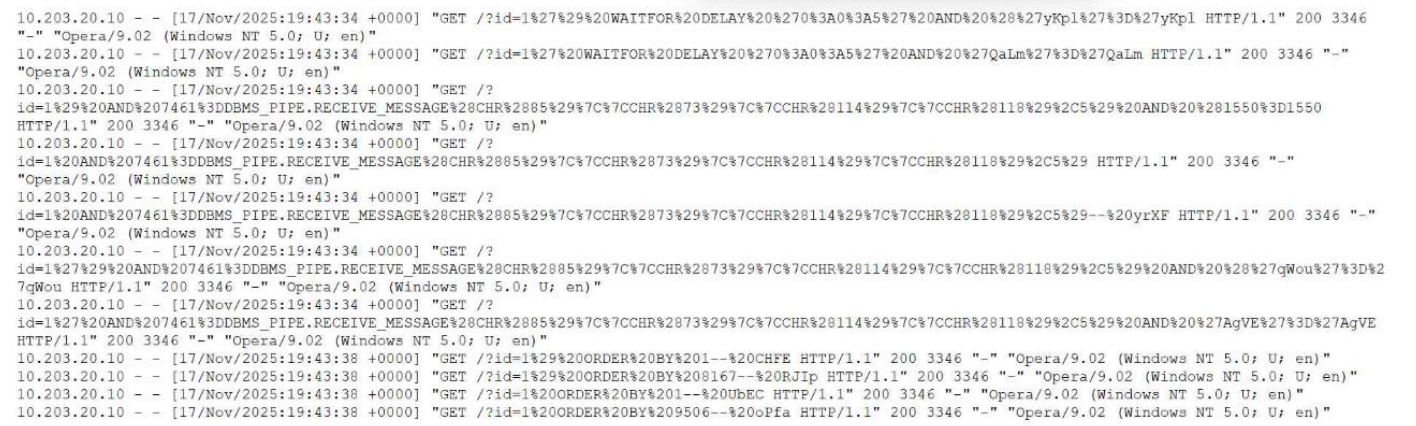
Selected indicators: source IP 10.203.20.10; 17/Nov/2025; GET; id; WAITFOR DELAY; DBMS_PIPE.RECEIVE_MESSAGE; ORDER BY; HTTP 200.
Which of the following attack attempts is occurring?
Moving from threats into architecture means shifting from what can go wrong to how you build systems that limit the damage when it does. This topic covers the security trade-offs embedded in architecture decisions: cloud deployment models, infrastructure design, data protection strategies, and resilience planning. The exam tests these as applied choices, not abstract principles. Where candidates lose marks is in treating architecture decisions as purely technical when the scenario introduces a business or regulatory constraint that changes the answer....
Moving from threats into architecture means shifting from what can go wrong to how you build systems that limit the damage when it does. This topic covers the security trade-offs embedded in architecture decisions: cloud deployment models, infrastructure design, data protection strategies, and resilience planning. The exam tests these as applied choices, not abstract principles. Where candidates lose marks is in treating architecture decisions as purely technical when the scenario introduces a business or regulatory constraint that changes the answer.
– Cloud and infrastructure architecture models
The exam presents architecture scenarios and asks which model best fits the described requirements. Cloud deployment models (public, private, hybrid, community) each carry different responsibility boundaries, and the shared responsibility model is implicitly tested whenever a cloud scenario describes a security failure. Serverless and microservices architectures reduce some attack surface while introducing others: the exam tests whether you know which. Infrastructure as Code introduces version control and automation benefits but also means a misconfigured template can be deployed at scale instantly. Air-gapped networks provide strong isolation but create operational challenges around patching and data transfer that the exam exploits in scenario questions. Operational technology environments have different availability and patching constraints than IT environments: treating them identically is a common wrong answer. Logical and physical segmentation are both valid but serve different threat models, and multicloud introduces complexity that affects both.
– Technical and business considerations in architecture decisions
Architecture decisions are never purely technical on this exam. Availability, resilience, and ease of recovery are technical properties, but cost, ownership, data sovereignty, and scalability are business constraints that can override the technically superior option. Data sovereignty is tested in scenarios involving multinational organisations: where data is stored and processed has legal implications that architecture must accommodate. Data classification drives architecture decisions about where sensitive data can reside and how it must be protected in transit and at rest. Proprietary versus open-source trade-offs appear in scenarios about vendor lock-in and auditability. Power requirements and environmental considerations are tested in the context of data centre design and physical resilience. The exam rewards candidates who can identify the business constraint in a scenario and select the architecture option that satisfies both the technical and non-technical requirements simultaneously.
– Zero Trust architecture and secure access
Zero Trust is not just a principle here: the exam tests its implementation components. User authentication, device health, device inventory, and application access control are the four pillars that a Zero Trust architecture validates before granting access. The exam will describe a network where a device has passed authentication but its health posture is unknown and ask what control is missing. VPN, tunneling, and remote access appear in contrast to Zero Trust models: traditional VPN grants broad network access once connected, which conflicts with least-privilege access at the application level. Security Service Edge consolidates network security functions at the cloud edge, and the exam tests it in scenarios about remote workforce security. Privilege creep, the gradual accumulation of access rights beyond what a role requires, is tested as a failure mode of identity management. Out-of-band management is tested in scenarios where the primary network path is compromised and you need an alternative to maintain control.
– Data protection strategies and roles
Data protection questions on this exam are almost always scenario-based: a data type, a state (at rest, in use, in transit), and a requirement are described, and you select the appropriate protection method. Masking, tokenisation, encryption, hashing, filtering, deidentification, and obfuscation are not interchangeable. Tokenisation replaces sensitive data with a non-sensitive substitute while preserving format; masking replaces characters but retains some original data; deidentification removes identifying elements. The data protection roles (owner, custodian, steward, operator, controller, subprocessor) appear in scenarios that ask who is responsible for a specific decision or failure. Data classification levels (sensitive, confidential, secret, top secret, restricted, critical) determine handling requirements. The data management life cycle (creation through disposal) is tested in scenarios about retention policy violations and disposal failures. Compliance categories (health data, personal information, financial, child data, intellectual property) link data classification to specific regulatory obligations.
– Resilience, recovery, and continuity
Recovery and resilience questions test whether you can select the right solution for a described availability requirement. Hot, warm, and cold sites differ in cost and recovery time: the exam will give you an RTO and ask which site type fits. RTO, RPO, MTTR, and MTBF are all tested quantitatively: know what each measures and which direction you want each metric to move. Load balancing, clustering, autoscaling, and high availability are not synonyms: each addresses a different failure mode. Immutable backups are tested in ransomware scenarios because they cannot be encrypted or deleted by an attacker who has compromised the primary environment. Restoration testing is the step most organisations skip, and the exam knows it: scenarios will describe a recovery failure and ask what preventive step was missing. Business continuity and disaster recovery are related but distinct: BC keeps operations running during an event, DR restores systems after one. Capacity planning appears because a system that runs out of resources during a crisis is a resilience failure.
How Security Architecture is tested
At 19% of the exam, Security Architecture items are predominantly scenario-based and require you to apply a principle to a described environment rather than recall a definition. The scenarios often include a constraint (budget, regulatory requirement, existing infrastructure) that eliminates one or more otherwise valid options.
Items in the resilience sub-topic reward candidates who know the precise relationship between RTO, RPO, MTTR, and MTBF. A scenario might describe a business requirement and ask which metric is being specified: candidates who treat these as interchangeable lose those marks.
The Zero Trust items are a frequent source of errors because candidates apply the principle correctly but miss an implementation component. The exam is testing whether you know all four validation pillars, not just whether you can define Zero Trust.
On data protection, the trap is selecting a method that provides confidentiality when the scenario actually requires integrity, or choosing encryption when the requirement is format-preserving tokenisation. Read the data state and the business requirement before selecting a method.
Security Architecture covers a wide range of scenario types, from cloud deployment trade-offs to recovery metric calculations. Checking your performance across all these sub-areas in the ITExamsTopics practice test is more efficient than re-reading the material: you will see exactly which architecture scenario types are costing you marks.
The scenario below presents an architecture decision with a specific business constraint. Identify which option satisfies both the technical and non-technical requirements.
Security Operations carries the highest weight on the exam and covers the widest operational scope: mitigating controls, asset management, vulnerability management, monitoring, identity and access management, automation, incident response, and forensic investigation. The breadth is intentional. This topic tests whether you can operate a security programme day to day, not just design one. Candidates who have strong conceptual knowledge but limited operational exposure tend to struggle here because the scenarios describe real conditions where multiple valid-looking options exist and the...
Security Operations carries the highest weight on the exam and covers the widest operational scope: mitigating controls, asset management, vulnerability management, monitoring, identity and access management, automation, incident response, and forensic investigation. The breadth is intentional. This topic tests whether you can operate a security programme day to day, not just design one. Candidates who have strong conceptual knowledge but limited operational exposure tend to struggle here because the scenarios describe real conditions where multiple valid-looking options exist and the difference between them is procedural precision.
– Mitigating controls and endpoint protection
The exam tests mitigating controls by presenting a described threat and asking which control or combination of controls addresses it. Segmentation, sandboxing, and deception technologies (honeypots, honeynets, honeyfiles, honeytokens, canary accounts) each serve a different purpose in a layered defence. Honeypots detect; canary accounts alert on credential misuse. Intrusion detection and prevention systems are tested by placement (network-based versus host-based) and by the distinction between detection and prevention modes. Firewalls appear in multiple forms: rule-based, WAF, UTM, and Layer 4 versus Layer 7 inspection each apply to different traffic types and threat models. EDR and XDR are tested in contrast: EDR operates at the endpoint, XDR correlates across endpoint, network, and cloud telemetry. Application controls (allow lists and block lists), DLP (agent-based and proxy-based), and network access control via 802.1X and captive portals are all scenario-tested. Email security protocols (DMARC, SPF, DKIM, BIMI) are tested together because they work as a stack: knowing what each validates and in what order matters.
– Asset management and vulnerability management
Asset management is tested as a life cycle: planning and scoping, acquisition, assignment, monitoring, and disposal each have security implications. Disposal and decommissioning questions are common because they describe a failure (data recovered from a discarded device) and ask what step was missing. Vulnerability management follows a separate life cycle: identification through scanning, IPAM, CSPM, and source code review; prioritisation using CVSS scoring and severity assessment; remediation; verification; and reporting. The exam tests the distinction between internal and external reporting and the role of responsible disclosure and bug bounty programmes. Prioritisation is where candidates lose marks: CVSS score alone does not determine remediation order. A high-CVSS vulnerability on an isolated, non-critical system may rank below a medium-CVSS vulnerability on an internet-facing system processing sensitive data. The exam rewards candidates who factor in asset criticality and exploitability alongside the base score.
– Monitoring, alerting, and SIEM
Monitoring questions test whether you can select the right tool for a described visibility requirement. SIEM aggregates and correlates logs from multiple sources; a packet analyser captures raw traffic; NetFlow provides flow-level metadata without payload content; SNMP monitors device health; syslog collects event data from infrastructure. The exam will describe a gap in visibility and ask which tool closes it. Alert tuning is tested because both false positives and false negatives have costs: too many alerts cause fatigue and real events get missed; too few mean genuine threats go undetected. Benchmarks and SCAP provide a baseline for configuration compliance monitoring. Port mirroring and agents versus agentless collection are tested in scenarios about monitoring coverage trade-offs. Dashboards and network management systems are the operational interface to all of this telemetry, and the exam tests what each is appropriate for.
– Identity and access management
IAM is one of the most heavily tested operational areas. Provisioning and deprovisioning, identity proofing, and account types (user, privileged, service, third-party, emergency) each carry distinct security requirements. Federation, SSO, SAML, LDAP, and OAuth are tested by protocol role: SAML passes authentication assertions between identity provider and service provider; OAuth delegates authorisation; LDAP queries directory services. MFA types (hard token, soft token, biometrics, OTP, backup code) are tested by their resistance to specific attacks: a soft token is more vulnerable to phishing than a hardware token. Access control models (role-based, mandatory, discretionary, time-based, just-in-time) are tested in scenarios that describe an access failure and ask which model would have prevented it. Password concepts including passkeys, passwordless authentication, and compromised credential monitoring reflect the current state of authentication practice. Account auditing and access reviews are tested as the controls that catch privilege creep over time.
– Automation, incident response, and forensic investigation
Automation questions test use cases (user provisioning, resource provisioning, anomaly detection, desired state management, ticket management) and their trade-offs: guardrails, process risks, and automation logic failures are all testable. CI/CD pipelines introduce security considerations around code deployment that the exam tests in operational scenarios. Incident response is tested through its phases: preparation (training, tabletop exercises, playbooks, simulation), identification, containment, eradication, recovery, and post-incident review. The exam rewards candidates who sequence these phases correctly and who know what each phase produces. Chain of custody, e-discovery, and digital forensics are tested in scenarios where evidence handling decisions determine whether evidence is admissible. Containment choices (quarantine versus isolation versus negotiation in a ransomware scenario) are tested by weighing business continuity against evidence preservation. Post-incident activities (lessons learned, root cause analysis, PIR) are tested as the mechanism that improves future response. Forensic data sources (memory dumps, bit-level copies, snapshots, packet captures, system images, log integrity) are tested by what each preserves and when each is appropriate.
How Security Operations is tested
At 27%, Security Operations generates more exam items than any other topic. The vast majority are scenario-based, and many present a situation where two or three options are technically defensible. The items reward the candidate who picks the most operationally appropriate action given the constraints described.
Incident response sequencing is a reliable source of errors. Candidates know the phases but apply them in the wrong order under scenario pressure: they jump to eradication before containment is complete, or they begin forensic collection without establishing chain of custody. Items reward the candidate who respects the sequence.
For IAM items, the trap is selecting an authentication mechanism that is strong in general but does not address the specific threat described. A biometric control does not help against a scenario where the threat is an insider with legitimate biometric credentials.
Vulnerability management items reward candidates who factor in asset context when prioritising remediation. Automation items reward candidates who identify the process risk in a described automation scenario, not just the efficiency benefit. Read every scenario for what the constraint is before selecting a control.
Security Operations covers eight distinct sub-areas, and the ITExamsTopics question bank lets you measure your performance across all of them in one session. Rather than guessing which areas need work, you can see your scores by sub-area and direct your remaining study time precisely.
The scenario below involves an operational decision with a procedural constraint. Work through the sequence before selecting your answer.
After the operational intensity of Security Operations, this topic pulls back to the governance layer: the policies, risk processes, third-party relationships, compliance obligations, audit activities, and awareness programmes that hold a security programme together at the organisational level. At 14%, it is the lightest topic by weight, but it is not thin material. The items here test whether you can operate within organisational and regulatory structures, not just technical ones. Candidates with a purely technical background often underestimate this topic...
After the operational intensity of Security Operations, this topic pulls back to the governance layer: the policies, risk processes, third-party relationships, compliance obligations, audit activities, and awareness programmes that hold a security programme together at the organisational level. At 14%, it is the lightest topic by weight, but it is not thin material. The items here test whether you can operate within organisational and regulatory structures, not just technical ones. Candidates with a purely technical background often underestimate this topic and pay for it.
– Governance artifacts: policies, standards, procedures, and plans
The exam tests governance documents by their function and hierarchy. Policies set direction; standards define specific requirements (password length, encryption algorithm); baselines establish a minimum acceptable configuration; guidelines offer recommended but non-mandatory guidance; procedures describe how to perform a task step by step. Runbooks and SOPs are both procedural but differ in scope: SOPs cover recurring operational tasks, runbooks address specific incident or operational scenarios. Plans (business continuity, disaster recovery, incident response) are tested in scenarios that describe a gap between what the plan requires and what actually happened. The exam will ask which document type is missing or which one was violated. Specific policy types (AUP, BYOD, clean desk, data classification and retention, access control, data disposal, vulnerability disclosure, privacy) are tested by their scope and what behaviour they govern. Advisories, implementation guides, and reference architectures are supporting documents that operationalise the policy layer.
– Risk management processes and quantitative risk analysis
Risk management is tested through the full process: identification, assessment, analysis, treatment, and ongoing review. The qualitative versus quantitative distinction matters because the exam tests both modes. Qualitative analysis produces a risk rating (high, medium, low); quantitative analysis produces financial figures. Single loss expectancy, annualised rate of occurrence, and annualised loss expectancy are calculated values that appear in scenario questions: know the relationships between them and what each represents. Risk treatment options (transfer, accept, avoid, mitigate) are tested by matching the treatment to the described scenario. Accepting residual risk after mitigation is a legitimate outcome, and the exam tests whether you know when it is appropriate. Risk appetite, business impact analysis, and stakeholder involvement are governance-level inputs to risk decisions. A risk register is the living document that tracks all of this: the exam tests what belongs in it and who is responsible for maintaining it.
– Third-party risk and vendor management
Third-party risk questions test the vendor lifecycle from selection through monitoring. RFP, RFI, RFQ, and EOI are pre-engagement documents with different purposes: an RFP solicits proposals, an RFI gathers market information, an RFQ requests pricing, an EOI establishes interest. Due diligence and conflict of interest checks are pre-contract controls. Agreement types (SLA, SLO, MOU, MOA, NDA, MSA, SOW) are tested by what each commits the parties to: an SLA defines measurable service levels; an MOU records intent without creating legal obligation; an MSA governs the overall relationship while individual SOWs define specific engagements. Right-to-audit clauses, vendor registries, and compliance attestation are ongoing monitoring controls. Vendor lock-in, staffing limitations, and geography and jurisdiction constraints are risk factors that affect what third-party arrangements are feasible. The exam will describe a vendor relationship failure and ask which pre-engagement or monitoring control would have caught it.
– Compliance, audit, and assessment activities
Compliance questions test the consequences of non-compliance (reputational damage, financial penalties, contractual breach, sanctions, loss of licence) and the privacy rights that compliance programmes must protect (right to be forgotten, opt-in and opt-out, data correction, processing restrictions, legal hold). The controller versus processor distinction is tested in scenarios about who bears responsibility for a data handling failure. Audit types (internal, external, independent third-party) and engagement types (gap analysis, compliance audit, self-assessment) are tested by their scope and independence level. The exam also tests assessment frameworks and methodologies: MITRE ATT&CK, the Cyber Kill Chain, and the Diamond Model of Intrusion Analysis each provide a different analytical lens. Penetration testing environments (known, unknown, partially known) and test types (offensive, defensive, integrated, physical) are tested by what each reveals and what it does not. Passive versus active reconnaissance is tested in the context of what evidence each leaves and what legal constraints apply. Industry, international, and region-specific standards appear in scenarios that describe a regulatory environment and ask which framework applies.
– Security awareness and training programmes
Awareness training is tested operationally, not philosophically. The exam will describe a training programme and ask whether the delivery mechanism, frequency, or targeting is appropriate for the described population and risk. Initial onboarding, ongoing, targeted, and corrective training each address different needs: corrective training is triggered by a specific behaviour or incident, not delivered on a schedule. Delivery mechanisms (LMS, self-service portals, one-to-one, one-to-many) are matched to audience size and content type. Reporting and monitoring of effectiveness through metrics and personnel behaviour risk scoring is tested because awareness training that cannot demonstrate impact is a governance gap. Common training topics (social engineering, password and credential management, BYOD, remote work, business email compromise, removable media, situational awareness, operational security) are tested in scenarios that describe an incident and ask which training topic, if addressed, would have reduced the likelihood. The exam rewards candidates who can connect a specific training gap to a specific incident type.
How Security Program Management and Oversight is tested
At 14%, this topic generates fewer items than the operational topics, but those items tend to be more abstract and require you to reason about organisational context rather than apply a technical control. Candidates who skim this topic in favour of more technical study often find the items harder than expected on exam day.
Risk quantification items reward candidates who know the SLE, ARO, and ALE relationships precisely. These are calculation questions: an error in which variable feeds which formula costs the mark.
Third-party agreement questions reward candidates who know the legal weight and scope of each agreement type. Confusing an MOU with an MSA, or an SLA with an SLO, produces a wrong answer even when the broader concept is understood.
Audit and assessment items reward candidates who distinguish between what different engagement types are designed to find. A gap analysis identifies the distance between current state and a target framework; a penetration test identifies exploitable weaknesses. These are not interchangeable, and items test that distinction.
Awareness training items reward candidates who connect training design decisions to measurable outcomes and specific incident types.
Security Program Management and Oversight is the topic candidates most often underprepare. The ITExamsTopics free demo includes items from this topic, so you can check your baseline on governance, risk, and compliance questions before committing to the full practice test.
The question below tests a risk management calculation from this topic. Work through the numbers before selecting your answer.
Ready to Start Practicing?
Access all questions and start your exam preparation journey
Upgrade to Full SY0-801 Exam Questions 🚀


